Twin auger juicers, also called twin gear or dual-gear slow juicers, use two interlocking gears to crush and press produce at low speeds. This design maximizes juice yield, minimizes oxidation, and preserves nutrients. The following selections highlight standout twin auger models alongside complementary slow juicers, offering reliable performance for American households seeking delicious, nutrient-packed juice.
| Product | Brand | Type | Key Benefit |
|---|---|---|---|
| Tribest Greenstar GS-1000 Original | Tribest | Twin Gear Slow Juicer | High-yield, nutrient-dense juice |
| Tribest Greenstar GS-5 | Tribest | Twin Gear Slow Juicer | Versatile for diverse produce |
| Tribest Greenstar GS-P501-B Pro Jumbo | Tribest | Twin Gear Slow Juicer | Enhanced extraction and cleaning ease |
| Omega VRT350 | Omega | Vertical Single Auger Slow Juicer | Quiet, high-yield slow juicing |
| Eurolux Slow Masticating Juicer | Eurolux | Slow Juicer (Single Auger) | Nutrient-rich juice with easy cleanup |
Tribest Greenstar GS-1000 Original Slow Masticating Juicer
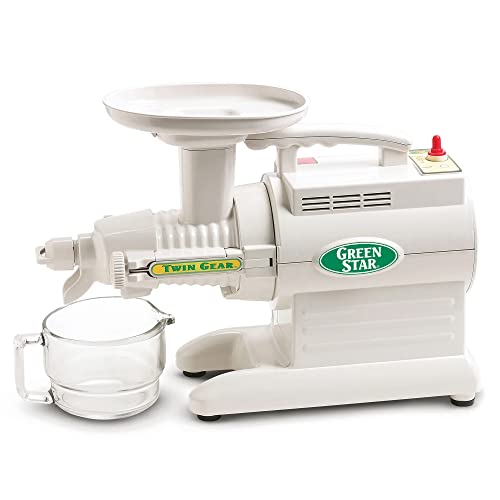
The GS-1000 is a twin-gear, magnetic and bioceramic technology-based juicer designed for quiet operation at low RPM. It uses a dual-gear system to crush and press produce, delivering nutrient-dense juice with minimal heat. The system aims to minimize pulp in the final juice and preserve enzymes, with a focus on stable juice quality over time. The model supports a wide range of fruits and vegetables, including leafy greens and harder produce, thanks to its robust twin-gear design and efficient extraction process.
Tribest Greenstar GS-P501-B Pro Jumbo

The GS-P501-B Pro Jumbo builds on Tribest’s twin-gear technology with an emphasis on easier cleaning and higher yield. Its Jumbo gear system processes a variety of produce, including hard and fibrous items, with a focus on maximizing juice extraction while reducing heat generation. The juicer’s design supports extended juicing sessions and can be paired with cleaning tools to simplify maintenance. It targets households seeking long-term reliability and superior nutrient retention.
Tribest Greenstar GS-5

The GS-5 offers the twin-gear extraction with a design optimized for a broad range of produce. It emphasizes durability, a quiet operation profile, and high-yield juice with preserved enzymes. The GS-5 supports diverse fruit and vegetable textures, including fibrous greens, through its dual-stage grinding and pressing mechanism. The unit aims to deliver consistent performance for household juicing routines and batch juice prep.
Omega VRT350 Heavy Duty Dual-Stage Vertical Juicer

The VRT350 uses a dual-stage vertical auger system designed for high-yield juice with minimal oxidation. It employs a slow, low-speed operation to extract nutrients and flavors, with a focus on producing smooth juice and a relatively dry pulp. The model emphasizes durable construction and a compact footprint, making it suitable for kitchen spaces that value efficiency and quiet performance.
Eurolux Slow Masticating Juicer

The Eurolux model focuses on maximizing nutrient retention through slow masticating operation at reduced speeds. It emphasizes quiet performance, easy disassembly, and dishwasher-safe parts for straightforward cleaning. While not a twin-gear design, it remains a competitive option for households prioritizing nutrient preservation and user-friendly maintenance in a compact package.
Buying Guide: Twin Auger Juicer Considerations
When evaluating twin auger juicers, consider these factors to match your needs:
- Juicing speed and yield: Twin-gear models operate at lower RPMs to maximize juice from tough produce while minimizing oxidation. Look for devices that emphasize high yield and minimal foam.
- Feed chute size: A larger feed chute reduces prep time by allowing whole fruits and larger vegetables to pass through. Some models offer 4–5.4 inch chutes for convenience.
- Cleaning and maintenance: Twin-gear juicers often come with cleaning brushes and components designed for easier disassembly. Consider dishwasher-safe parts and the complexity of the gear assembly.
- Juice quality and nutrient retention: Magnetic, bioceramic or other proprietary gear technologies can influence enzyme preservation and flavor stability. Check for certifications and user reviews on freshness.
- Durability and warranty: Twin-gear systems are mechanical investments. Look for solid build materials (stainless steel housing, durable gears) and favorable warranty terms (some brands offer multi-year coverage).
- Noise level: While slow juicers are generally quiet, some models emphasize quieter operation due to gear design and motor tuning. This matters for early morning or late-night juicing.
- Versatility: Some twin-gear juicers support leafy greens, fibrous produce, and soft fruits with interchangeable screens or strainers. If you plan to juice a wide range of produce, choose a model with multiple strainers and easy switching.
- Maintenance access: Models with easy-to-clean housings or integrated cleaning tools reduce downtime between batches and encourage regular use.
Overall, twin auger juicers are favored for their efficient extraction and ability to preserve nutrients. For everyday American kitchens, selecting a model with a balance of yield, ease of cleaning, and durability will support consistent, nutrient-rich juice preparation.