For home bakers and hobbyists, choosing the right dough rolling board can streamline pastry prep and keep counters clean. This guide highlights five top options that balance durability, measurement accuracy, and ease of use. Each product below links to Amazon for quick reference and features a mix of wooden boards, silicone mats, and dual-sided surfaces to accommodate pie crusts, pizzas, cookies, and more.
Summary of chosen products
| Product | Brand | Key Feature | Size |
|---|---|---|---|
| Montex Pastry Board | Montex | 2-in-1 dual sides with laser-etched measurements | 24” x 20” |
| QUELLANCE Silicone Baking Mat | QUELLANCE | 0.7mm thick, large rolling surface with measurement grid | 28” x 20” |
| Folksy Super Kitchen Silicone Mat | Folksy Super Kitchen | Premium silicone, non-stick, extra thickness | 28” x 20” |
| SoeKoa Reversible Wood Board | SoeKoa | Double-sided with engraved ruler; edge blocking | 20” x 24” |
| OKeanu Silicone Mat | OKeanu | Extra large, non-slip, 1.5mm thick; 4mm edge height | 24” x 16” |
Montex Pastry Board With Measurement 24” x 20”

The Montex Pastry Board is a two-in-one surface designed for rolling dough and functioning as a cutting board. One side features clear measurements for precise pie crusts and dough sizing, while the reverse side serves as a sturdy work surface for chopping vegetables and ingredient prep. The board uses high-quality rubber wood for durability and hygiene, with a smooth surface that’s easy to clean. Laser-etched measurements include square and circular guides, plus flour and sugar references, reducing the need for extra tools during baking.
QUELLANCE Silicone Baking Mat With Measurements 28×20

The QUELLANCE baking mat offers a 28×20 inch work surface with a 0.7mm thickness, designed to resist warping while kneading dough. Made from 100% food-grade silicone, it provides a non-stick surface that minimizes flour usage and easy cleanup. Its thick construction helps prevent edge curling, keeping the mat flat on the counter during rolling and shaping tasks. This mat is suitable for dough, fondant, pie crusts, and other kneading needs, and its measurement grid supports precise sizing of dough portions.
Folksy Super Kitchen Nonstick Silicone Mat 28×20
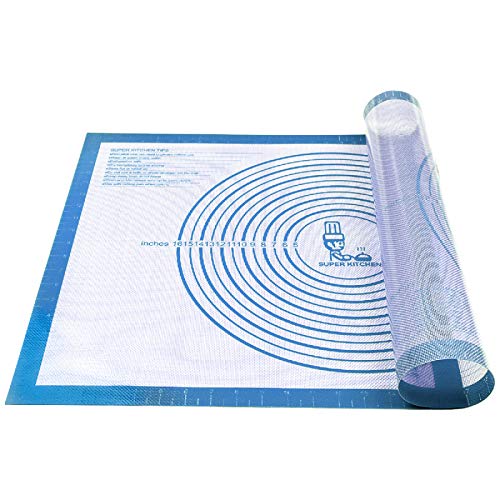
This extra-large silicone pastry mat from Folksy Super Kitchen provides a premium, non-stick surface with a thick 0.7mm construction to reduce rolling issues. The mat’s non-slip bottom helps keep it in place on countertops during kneading and rolling, while the durable silicone surface tolerates heat and repeated use. It’s suitable for a wide range of dough tasks, including pie crusts, cookies, fondant, and rolling out soft doughs like bread dough.
SoeKoa Reversible Wood Pastry Board 20×24

The SoeKoa reversible wood pastry board features dual measurement guides on both sides for flexible dough sizing. An edge-blocking lip helps contain flour and dough, while an integrated juice groove simplifies cleanup. This 20″ x 24″ board is well-suited for rolling dough for pizzas, pies, and other pastries. The wood surface offers a natural feel and is easy to clean, though it may require occasional oiling to maintain its finish and longevity.
OKeanu 24×16 Silicone Pastry Mat

The OKeanu mat measures 24×16 inches and emphasizes a strong non-slip bottom combined with a durable 1.5mm silicone surface and a 4mm edge height. Its generous size provides ample space for rolling dough, fondant work, and cookie shaping. The mat’s food-grade silicone is non-stick, making cleanup straightforward and reducing the need for flouring the surface. It’s designed to stay planted on the counter during heavy kneading tasks and offers a reliable foundation for keeping work surfaces clean.
Buying Guide: Key Considerations When Selecting a Dough Rolling Board
- Material and durability: Wooden boards offer a sturdy cutting surface and a traditional feel, but silicone mats provide exceptional non-stick properties and easy cleanup. Choose based on how you balance aesthetics, maintenance, and longevity.
- Size and workspace: Large boards (24×20 or bigger) provide more room for rolling out pie crusts and pizzas, while compact boards fit smaller counters. Consider your typical recipes and counter space.
- Measurement aids: Laser-engraved or printed grids help with precise dough sizing. Two-sided boards add versatility but may require more cleaning and storage attention.
- Non-slip features: A non-slip bottom or edge lips reduce movement during rolling, improving accuracy and safety.
- Ease of cleaning: Silicone mats are generally easier to clean and sanitize, while wood boards may require oiling and careful drying to prevent warping or cracking.
- Multi-functionality: Some boards double as cutting boards or have juice grooves. Consider whether you prefer single-purpose tools or multi-use surfaces for space-saving.
- Care and maintenance: Wooden boards often need occasional conditioning with food-safe oil, while silicone mats usually wash clean in warm water or with mild soap.
- Price and availability: Compare sets or bundles that include rolling pins or dough cutters. Value often comes from a combination of size, features, and material quality.
In summary, for precise dough work and convenient cleanup, dual-surface boards like the Montex or the SoeKoa reversible board provide versatility, while large silicone mats from QUELLANCE, Folksy Super Kitchen, and OKeanu deliver excellent non-stick performance with generous work areas. Depending on your kitchen layout and how you prefer to work, any of these options can enhance dough rolling efficiency and pastry quality without adding clutter.