Best Cooking Tools for 10-Year-Olds: Safe Kitchen Sets for Young Chefs
Post published:February 7, 2026
Choosing the right cookware and utensils for a budding chef helps build confidence, skills, and a lifelong love of cooking. The following picks are designed for 10-year-olds, offering safety features, kid-friendly designs, and practical tools that support real cooking activities. Each option emphasizes durable materials, clear measurements, and age-appropriate responsibilities so children can learn by doing in a supervised environment.
Summary of Selected Products
Product
Brand
Key Benefit
44Pcs Kids Cooking & Baking Set
Suhctuptx
Real kitchen tools with safety-focused design for ages 6-10
40Pcs Kids Knife Set
Hirger
Comprehensive tool bundle with non-toxic materials and safety features
Aieve Kids Cooking Sets Real, 28 Pcs
AIEVE
Real cooking set with guide recipes and durable, heat-tolerant materials
Tovla Jr. 3-Piece Safe Knife Set
Tovla
STEM-friendly, safe serrated design for young cooks
28PCS Toddler Knife Set
Suhctuptx
Montessori-style tools with variety and kid-friendly safety
This 44-piece set is designed for aspiring chefs aged 6 to 10 and includes a range of utensils tailored to small hands. The collection features nylon knives, whisks, rolling pins, spoons, offset scrapers, a timer, mats, and measuring tools. By combining practical tools with beginner-friendly design, it supports hands-on learning in baking and cooking while emphasizing kitchen safety.
Safety is a central focus: the kid-friendly knife is soft-edged and designed to work with soft ingredients, helping children learn safe slicing techniques. The handles are crafted to fit smaller grips, promoting confidence as they practice cutting, stirring, rolling, and measuring. The included recipe-inspired activities help children connect steps to outcomes, encouraging curiosity and responsible kitchen behavior.
Educational value comes through practical application: children can practice basic nutrition by preparing simple snacks and learn sequencing, timing, and multitasking in a real kitchen setting. The set’s diverse tools also encourage creativity—kids can experiment with dough, toppings, and different textures, while parents observe technique and safety habits that set the stage for more advanced cooking in the future.
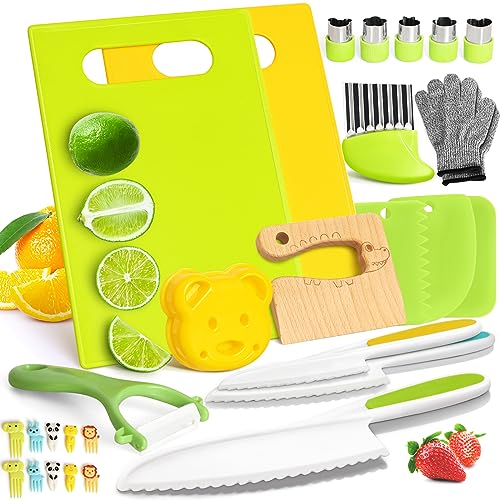
The 40-piece set provides a well-rounded toolkit for young culinarians, featuring four kid-safe knives, a wooden knife, cutting boards, a peeler, a crinkle cutter, and various cutting molds. The assortment is designed for real cooking activities while maintaining child-friendly safety features, making it suitable for classroom-style practice or home play.
Materials emphasize safety and durability: food-grade polypropylene, wood, and stainless steel are used to minimize risk while withstanding regular use. The non-slip handles are sized for small hands, supporting precise control during chopping, slicing, and dicing. The integrated wooden knife design further reduces risk while enabling children to build real motor skills and confidence in the kitchen.
In use, the kit supports essential culinary basics: knife skills (safely practiced), basic food prep, and routine kitchen tasks like peeling and slicing. The range of tools helps children approach cooking as a measured, repeatable process, which can be reinforced by simple recipes or guided experiments at home or in a classroom setting.
Aieve Kids Cooking Sets Real, 28 Pcs
The Aieve 28-piece kit is designed to engage children aged 6-12 with a realistic kitchen experience. It includes a chef’s hat and apron, measuring spoons, silicone cookware, knives, bowls, a cutting board, a pizza cutter, and an accompanying cooking guide. The set emphasizes safe handling through materials that are BPA-free and dishwasher-safe, with heat tolerance up to 180 degrees for practical cooking tasks.
Beyond tools, the included recipe guidance supports structured learning: ingredients, quantities, steps, techniques, and cooking times are broken down clearly. This approach helps children develop measurement literacy, sequencing, and an understanding of how different tools complement each stage of a recipe. The storage bag keeps everything organized, reinforcing responsibility and care for kitchen equipment.
Durability and maintenance are practical considerations: the blend of stainless steel, plastic, and silicone ensures longevity with regular use, while dishwasher compatibility makes cleanup straightforward for young cooks and supervising adults.
Designed to blend safety with practical kitchen utility, the Tovla 3-piece set is marketed as a STEM-friendly option for ages 4–12. The safe serrated design lets kids slice fruit and vegetables while minimizing finger risk, making it ideal for early culinary exploration. The set is aligned with Montessori-inspired learning, encouraging independence, confidence, and careful technique in real cooking tasks.
The blades are engineered to cut efficiently without being sharp to the touch, and the blades are paired with ergonomic, kid-sized handles. This combination supports fine motor development and safe handling skills as young chefs learn how to grip, guide, and slice with control. The kit’s portability makes it suitable for at-home practice or classroom demonstrations that emphasize practical math and science connections to cooking.
Overall, the Tovla set offers a balanced introduction to real cooking tools for children, with a focus on safety, independence, and cognitive engagement through hands-on activity and guided exploration of food preparation.
This Suhctuptx bundle offers a Montessori-inspired assortment geared toward toddlers and early elementary kids. The kit includes a wooden knife, several kid-friendly serrated knives, a glove, a potato slicer, fruit cutters, and a variety of cutting boards and fruit forks. The design emphasizes safe handling, non-toxic materials, and a one-piece handle concept to reduce risk during use.
The tool mix supports multi-skill development: cutting, slicing, shaping, and even basic food presentation. The included accessories like fruit cutters and a bear-shaped cutter introduce playful elements that keep children engaged while practicing careful technique. The set’s portability and compact storage help maintain organization in busy family kitchens or classroom spaces.
Safety is central, with BPA-free materials and carefully chosen components that are durable yet gentle for young cooks. Children can explore basic knife skills in a structured, supervised context, building a foundation for more advanced culinary tasks as they grow.
Buying Guide: Key Purchase Considerations And Comparisons
Age suitability and safety features are the top priorities when selecting cooking tools for children. Look for rounded edges, blunt blades, and non-slip, comfortable handles that accommodate small hands. Materials should be BPA-free, non-toxic, and easy to clean. Consider whether a set includes a guide or recipes to support learning and independent practice.
Tool variety matters: a balanced mix of knives, utensils, cutting boards, and molds encourages broader skill development, from slicing and dicing to measuring and timing. Some sets incorporate real kitchen elements (like rolling pins and timers) to foster a sense of authentic cooking, while others emphasize Montessori-style play with safe, kid-friendly pieces.
Durability is essential for long-term use. Sets that combine plastic with wood or stainless steel components typically offer better longevity. Storage solutions—such as bags, boxes, or organizers—help keep tools accessible and reduce clutter, promoting responsibility in young chefs.
Educational value can come from recipe guides, structured activities, and clear instructions. Products that connect cooking steps to outcomes (e.g., baking cookies or bread) help children understand sequencing, measurement, and nutrition concepts, while also encouraging experimentation and creativity in a supervised setting.
Skill progression is another consideration. Start with basics like safe grip training and simple cutting techniques, then gradually introduce more complex tasks and tools as confidence grows. Parental involvement remains important for safety and guidance, especially for younger or newly practicing cooks.
In comparing the options listed, consider how each kit aligns with a child’s current interests—baking, savory cooking, or classroom-style STEM activities—and the ease of integrating the tools into regular kitchen routines. The best choice balances safety, educational value, durability, and, importantly, the child’s enthusiasm for cooking.