Choosing the right grain mill can improve mash efficiency, preserve husks for sparging, and speed up your brewing workflow. The following selections are focused on malted barley and malted wheat, with options for manual operation or easy drill-assisted grinding. Each model offers adjustable crush settings, large hoppers for batch brewing, and solid construction for repeated use. Read on for a quick comparison, followed by detailed product sections and a practical buying guide to help you pick the best mill for your beer recipes.
| Product | Brand | Key Benefit |
|---|---|---|
| FERRODAY Malted Grain Mill – 2 Roller | Ferroday | Large hopper; adjustable gap; drill adaptability |
| Brewland Grain Mill (7.7LB Hopper) | Brewland | High capacity hopper; dual grinding modes |
| Brewland Grain Mill Pro (13LB Hopper) | Brewland | Largest hopper; rugged steel base |
| Northern Brewer Hullwrecker 2-Roller | Northern Brewer | Well-known reliability; precise roll gap |
| FERRODAY Malt Mill 2 Roller Stainless Steel | Ferroday | Durable stainless steel build; adjustable clearance |
FERRODAY Malted Grain Mill – 2 Roller

The FERRODAY Malted Grain Mill features two 5-inch rollers with 12 TPI knurling to pull grains through while preserving hulls for effective sparging. A large 7.7 lb hopper supports high-volume mashing, and the clearance is adjustable from 0.025 to 0.1 inch to dial in the grind for malted barley and wheat. The model supports a drill mode for high-throughput brewers who want to maximize mash efficiency, though the drill should be low-speed for longevity. This mill is designed specifically for malted grains rather than corn or soybeans, making it a solid pick for beer-focused homebrewers.
Brewland Grain Mill (7.7LB Hopper)
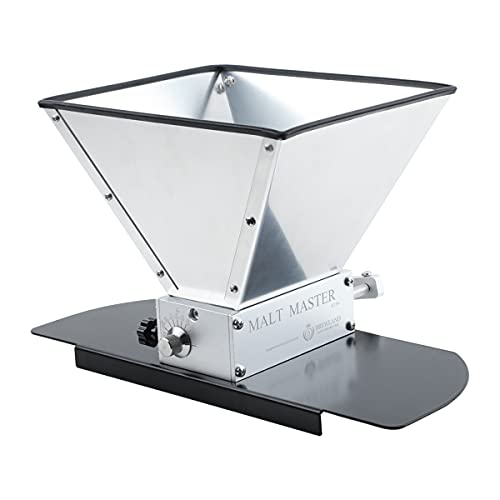
Brewland positions this grain mill as a brewing-focused option with a 7.7 lb hopper and dual grinding modes. An 8-position calibration knob adjusts the roller spacing from 0.025 to 0.1 inch, enabling precise control over malt extraction while protecting husks. Operators can manually crank for traditional milling or attach a low-speed drill for faster throughput. The design emphasizes reliability for homebrewers who run larger batches or want to streamline batch processes without sacrificing malt integrity.
Brewland Grain Mill Pro with 13LB Hopper

The Brewland Pro expands capacity with a 15 lb-ish sized hopper and a robust steel base. It shares the same 8-point calibration range (0.025–0.1 inch) for precise milling and offers two grinding modes: manual crank and drill-assisted operation. For brewers who regularly brew large volumes or want a quicker turnaround between batches, the Pro model combines capacity with dependable build quality. It’s compatible with standard drill adapters and aims to deliver consistent crush while maintaining hull integrity for efficient lautering.
Northern Brewer Hullwrecker 2-Roller
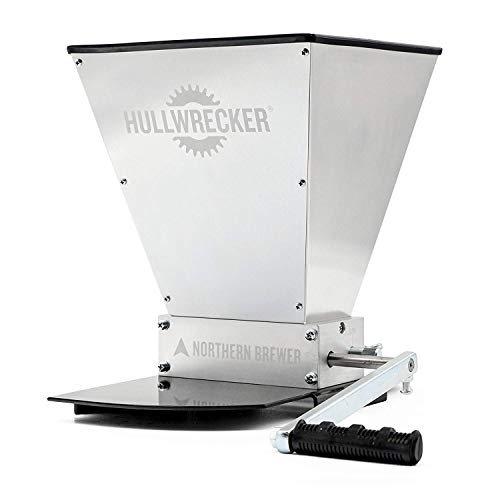
The Hullwrecker is a trusted two-roller mill with a metal base designed to fit on standard beer brewing buckets. Its fully adjustable roller gap ranges from 0.025” to 0.1”, allowing fine-tuning for your preferred mash profile. This model emphasizes dependable construction and straightforward operation, reducing the risk of inconsistent crush. It is especially popular among homebrewers who value a simple, reliable milling setup with a ready-made bucket mounting solution.
FERRODAY Malt Mill 2 Roller Stainless Steel
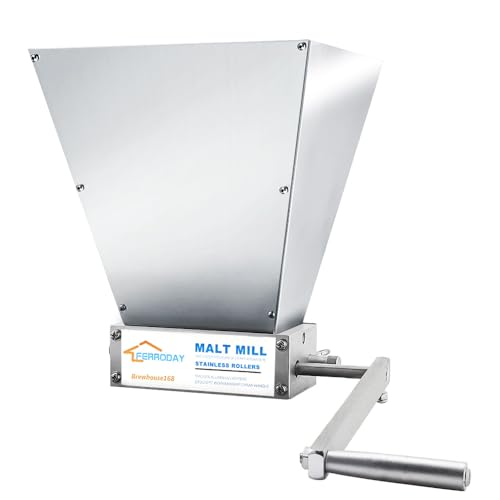
This FERRODAY model leverages a stainless steel build for the rollers and a corrosion-resistant design, complemented by an aluminum alloy crank and hopper. It offers a 7.7 lb grain capacity and an adjustable roller gap (0.025–0.1 inch) to optimize malt crush and extraction. The drill mode is supported via a low-speed attachment, giving brewers flexible operation for large-batch mashing. A compact, durable choice suitable for serious homebrewing setups that prioritize long-term reliability.
FERRODAY Malt Mill 2 Roller Stainless Steel (No Base)

Another FERRODAY option emphasizes a heavy-duty 2-roller stainless steel design with a 7.7 lb hopper and adjustable clearance from 0.025 to 0.1 inch. It is designed to maximize mash efficiency by producing a consistent crush while preserving hulls. The drill-enabled feature makes it suitable for larger brews, though it is sold without a base, so you may need to pair it with a stand or platform for stable operation. This mill balances durability with practical grind control for beer-focused brewers.
Buying Guide: Key Purchase Considerations And Comparisons
- Hopper capacity: Larger hoppers (7.7–15 lbs) enable bigger batches without frequent refilling, ideal for weekend brewers or small-scale commercial setups.
- Crush control: Look for adjustable roller gaps (approximately 0.025–0.1 inch) to tailor crush for different malt types and mash profiles. Consistent particle size improves efficiency and extraction.
- Drill compatibility: If you plan to automate grinding or speed up batch production, check that the mill supports a low-speed drill attachment and that the mechanism remains safe and stable at higher throughput.
- Construction and durability: Stainless steel rollers and a robust frame resist wear and corrosion, especially with frequent wet environments common in brewing.
- Base and stability: A solid base or purpose-built stand helps keep the mill steady during operation, reducing the risk of spills and improving consistency.
- Grain suitability: Most of these mills are designed for malted barley and malted wheat. Avoid using corn, soybeans, or sugarcane unless explicitly supported by the manufacturer.
- Maintenance: Easy cleaning and accessible screws for quick maintenance can save time between brews. Check for removable cranks or parts for thorough cleaning.
- Price-to-value: Compare hopper size, drill compatibility, and build quality. For frequent large-batch brewers, higher-capacity models with sturdy bases offer long-term value.
- Compatibility with existing equipment: If you already use a standard bucket or a specific mash tun, ensure the base or mounting solution aligns with your setup.