Choosing the right cutting mat can protect surfaces and extend blade life while offering precise alignment for sewing, quilting, and craft projects. This guide highlights five high-density, self-healing mats that excel in fabric cutting, quilting accuracy, and durability. Each option supports rotary cutters and straight blades, and multiple sizes cover small to large projects. Read on to compare density, layering, interlayers, and anti-cut features to find the best cutting board for sewing needs.
Summary of chosen products
| Product | Brand | Size | Key Strength |
|---|---|---|---|
| Density-upgraded 24″ x 36″ Large Self Healing Sewing Mat | Idemeet Store | 24″ x 36″ | High density, durable interlayers |
| Self Healing Sewing Mat, 12″ x 18″ | anezus Store | 12″ x 18″ | Double-sided, compact for small projects |
| Density-upgraded 18″ x 24″ Self Healing Sewing Mat | Idemeet Store | 18″ x 24″ | Balanced density and durability |
| Rotating Cutting Mat 12″ x 12″ | The Quilted Bear Store | 12″ x 12″ | 360° rotation for precision |
| Self Healing Cutting Mat, 18″ x 12″ | Idemeet Store | 18″ x 12″ | Dense, double-sided |
Density-Upgraded 24×36 Large Self-Healing Mat

The 24″ x 36″ Idemeet self-healing mat is built for serious sewing and crafting workloads. It weighs around 2600g, reflecting a high-density construction that enhances self-healing performance and extends mat life. The product features premium thickened buffer layers beneath the self-healing surface, providing blade cushioning and protecting underlying work surfaces. An interlayer adds anti-cut strength and reduces the risk of cracking, improving overall durability for rotary cutters and straight blades.
This mat suits large fabric projects such as quilt backs, garment panels, and craft boards where ample cutting area is essential. Its density-focused design aims to resist gouges and maintain a smooth cutting plane across repetitive passes. Users seeking long-term performance and minimal blade wear may find this mat particularly valuable for frequent creating sessions.
Anezus Self Healing Sewing Mat, 12×18

The Anezus mat measures 12″ x 18″ and is designed for compact craft spaces. It uses a 5-layer PVC structure with a white hardness core to help prevent through-cuts, maintaining a consistently smooth cutting surface. The mat is ideal for smaller sewing, scrapbooking, and hobby projects where portability and quick setup matter. Its double-sided surface increases longevity, offering repeated use for various projects without needing a larger workspace.
Compatibility with rotary cutters and straight blades ensures blade longevity, while the resealing surface maintains a smooth texture after multiple cuts. This mat is particularly suitable for hobbyists, quilters, and crafters who frequently switch between different small-scale tasks.
Rotating Cutting Mat 12″ x 12″
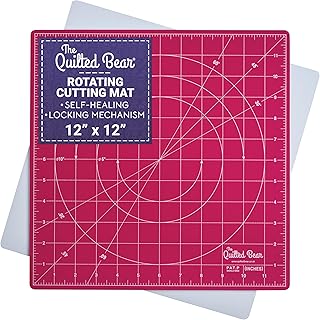
The Quilted Bear 12″ x 12″ rotating mat offers 360-degree rotation for precise fabric alignment during quilting and sewing. Its precision locking mechanism switches between rotating and fixed modes, improving stability on any craft surface. Self-healing technology minimizes visible cuts while maintaining a smooth surface, which helps extend the mat’s life across numerous projects. This model is excellent for small-scale sewing tasks, garment alterations, and detailed quilting that benefits from adjustable angles without repositioning fabric manually.
Self Healing Cutting Mat 18×12

This 18″ x 12″ Idemeet mat uses a density-upgraded design with roughly 600g weight for A3-sized projects. The mat emphasizes a thickened anti-cut interlayer and buffer layers that cushion the blade during cutting, reducing risk to the desktop surface. It is well-suited for moderate sewing tasks, scrapbooking, and light modeling projects where a portable, durable surface is preferred. The double-sided construction further extends usability for a variety of craft applications.
Buying Guide: Key Purchase Considerations
- Size and work area: Choose based on project scale. Large mats (e.g., 24″ x 36″) are ideal for quilts and garment panels, while smaller mats suit detailed work and portability.
- Density and durability: Higher density generally improves self-healing performance and blade longevity. Look for mats with integrated buffer layers for blade cushioning.
- Interlayer strength: A strong anti-cut or white interlayer reduces chipping and cracking, protecting the surface underneath and maintaining a stable cutting plane.
- Rotating features: For fabric alignment and precise angles, rotating mats with locking mechanisms can reduce wrist strain and increase accuracy.
- Double-sided and longevity: Double-sided mats offer extended life and more cutting surfaces, especially valuable for frequent crafters.
- Blade compatibility: Ensure the mat is designed to work with standard rotary cutters and straight blades common in sewing and quilting.
- Portability vs. stability: Balance the need for a portable mat with the requirement for a stable cutting surface on a chosen worktable.
Consider the typical fabrics, projects, and workspace when selecting a mat. For frequent, large-scale sewing and quilting, higher-density mats with robust interlayers provide the best balance of longevity and performance. For compact studios or occasional hobby use, smaller, double-sided or rotating mats offer practical versatility without sacrificing cutting quality.