Portable food warmers provide convenient, on-demand heat for meals when microwaves aren’t available. This guide highlights five reliable options, covering car, office, and travel scenarios. Each product competes on speed, capacity, and compatibility, helping you choose the right model for daily commutes, road trips, or remote work sites.
| Product | Capacity | Power | Voltage | |
|---|---|---|---|---|
| DUPASU Electric Lunch Box | 1.8 L main | 100 W | 110–230 V / 12/24 V | |
| SOHIDA 80W Electric Lunch Box | 1.5 L main | 80 W | 12/24/110 V | |
| SOHIDA 1.8L+0.5L Heated Lunch Box | 2.3 L total | 80 W | 12/24/110 V | |
| ROTTOGOON Portable Mini Oven | 1.5–1.8 L container options | Digital, up to high temps | 12/24/110 V | |
| LunchEAZE Pro Cordless Heated Lunchbox | 4-cup capacity | Battery-powered, cordless | Cordless, battery |
DUPASU Electric Lunch Box – 100W Fast Heating

The DUPASU electric lunch box offers rapid heating with a robust 100 W element, designed to reheat leftovers quickly while maintaining food freshness. The 1.8 L stainless steel main container supports a substantial meal, complemented by a 0.45 L salad box. A leak-resistant silicone-sealed lid helps prevent spills in transit. It operates across multiple power sources—110–230 V for home or office use and 12/24 V for cars and trucks—making it suitable for commuters, truck drivers, and travelers who lack reliable microwave access. A detachable fork and spoon pair adds convenience, while a caution to open the exhaust cover before heating helps manage pressure during operation.
Key features to consider: fast heating for busy days, durable food-grade materials, multi-voltage compatibility, and built-in accessories that support on-the-go meals. Preserve texture and flavor with proper pre-heating and by avoiding heating non-reheatable components (the included 0.45 L salad box, for example, isn’t heating-safe).
SOHIDA Electric Lunch Box – 80W, 12/24/110V

The SOHIDA portable warmer is engineered for broad voltage compatibility, supporting 12V, 24V, and 110V power sources—ideal for drivers, office workers, or outdoor professionals who switch between vehicles and workspaces. Its 1.5 L stainless steel container maintains flavors and freshness, paired with a separate 0.45 L compartment for sides (note: the smaller compartment cannot be heated). Heating at 80 W delivers meal warmth in roughly 25–40 minutes, balancing speed with energy efficiency. This model emphasizes reliability in diverse environments, with a focus on practical capacity and straightforward operation.
Considerations include heat-up time, container materials, and the separate compartments that influence how you portion meals. If you need to heat larger quantities, plan around the main 1.5 L capacity and remember that the small side container is not intended for heating.
SOHIDA 1.8L+0.5L Heated Lunch Box
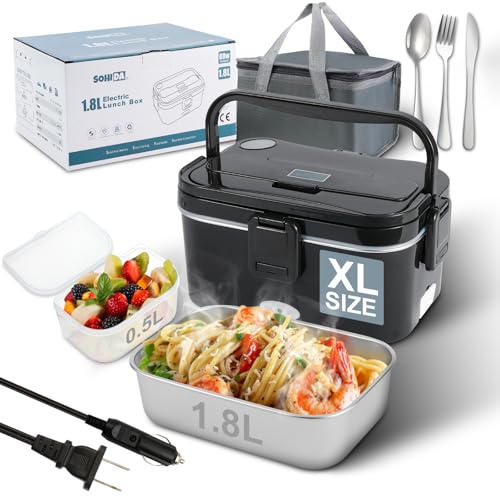
This SOHIDA model expands capacity to 2.3 L total with a larger 1.8 L main compartment and an extra 0.5 L side dish container, designed for more substantial meals. The included long-handled utensils—spoon, fork, and knife—enhance usability for adults with larger hands. A built-in stand for the utensils doubles as a phone stand for hands-free viewing during meals. With 80 W heating, most meals reach serving temperature within 25–40 minutes, reducing waiting time for hot lunches when microwaves aren’t available. The larger capacity makes it suitable for longer shifts or shared meals.
Practical notes include the 0.5 L side dish not being heat-safe and needing separate handling. The improved utensils and stand add to daily convenience, especially in office, truck, or outdoor settings where portability matters as much as heat retention.
ROTTOGOON Portable Mini Oven – 12V/24V/110V

The ROTTOGOON portable heater combines a multi-voltage design with digital temperature control, enabling precise heating while preserving moisture. Its 4-in-1 capability supports 12V, 24V, and 110V connections, making it versatile for cars, trucks, homes, and campsites. The conduction heat approach helps prevent overheating and keeps meals moist, aiming to deliver evenly heated food without drying out. This model is positioned as a compact, road-tested option for road trips, camping, and emergency meal preparation, with user-friendly temperature monitoring and a focus on consistent warmth over time.
When evaluating this option, consider container compatibility, heating duration for different meal types, and how digital controls translate into real-world results during long drives or variable power availability. The ability to heat a variety of containers can improve overall meal planning in mobile contexts.
LunchEAZE Pro Cordless Heated Lunchbox

The LunchEAZE Pro offers cordless heating powered by an 8000 mAh rechargeable battery, enabling hot meals without being tethered to a power outlet. Programmable mealtime settings enable “set it and forget it” operation, delivering hot, ready-to-eat meals on a schedule. Its 4-cup capacity suits individual portions or small shareable meals, making it ideal for travelers, hikers, or workers who move between sites. The cordless design provides flexibility for locations with limited electricity access, while still delivering reliable warmth when plugged in is not possible.
Key considerations include battery life for longer days, the reliability of scheduling features, and how the 4-cup capacity aligns with your typical meal portions. For those who prioritize mobility and independence from power sources, this model represents a strong option in the cordless category.
Buying Guide: Key Purchase Considerations
- Heat speed and efficiency: If you need quick meals, favor models with higher wattage (where safe and compatible with your power source) and short heat times. Some 80–100 W units heat faster than low-wattage alternatives, though results vary by container type and initial food temperature.
- Capacity and flexibility: Consider main compartment size and any additional side compartments. For larger meals or multiple side dishes, models with 1.8–2.3 L total capacity are beneficial, but weigh against portability.
- Power compatibility: Look for multi-voltage support (12V/24V/110V) for car, truck, home, and office use. If you travel between vehicles and destinations with different outlets, this reduces the need for adapters.
- Container materials and safety: Food-grade materials and leak-resistant lids help protect meals during transit. Note any compartments that are not heat-safe and plan your packing accordingly.
- Utensils and accessories: Built-in utensils, stands, or compatibility with larger containers can affect daily usability. Consider whether a kit includes adapters, heating plates, or carrying cases.
- Portability vs. performance: Some models emphasize cordless operation, which improves mobility but may require periodic recharging and may have shorter heating durations.
- Durability and ease of cleaning: Stainless steel interiors and robust lids reduce wear over time and simplify cleanup after meals.
- Use case alignment: Choose a model that fits your routine—long work shifts, road trips, or camping—balancing heat speed, capacity, and electricity access.