Choosing the right roller mill can boost mash efficiency and save time in homebrewing. The following selections focus on durable construction, adjustable roller gaps, and power options (manual or drill-assisted) to help you optimize grain crush for better sugar extraction and consistent brews. Below is a summary of five highly relevant options and their standout features for American homebrewers.
| Product | Brand | Notable Features | Hopper Capacity |
|---|---|---|---|
| Northern Brewer – Hullwrecker 2-Roller | Northern Brewer | Fully adjustable roller gap; all-metal base; solid dependability | Base fits standard 5–6.5 gallon buckets |
| FERRODAY Malted Grain Mill – 2 Roller | Ferroday | 12 TPI knurls; adjustable gap 0.025–0.1 inch; drill-ready | 7.7 lb hopper |
| Brewland Grain Mill (7.7 lb) | Brewland | 2 grinding modes; 7.7 lb hopper; drill compatible | 7.7 lb |
| Brewland Grain Mill Pro (15 lb) | Brewland | 3 rollers; larger 15 lb hopper; drill-ready | 15 lb |
| FERRODAY Malt Mill 2 Roller Stainless Steel | Ferroday | 7.7 lb hopper; drill mode; adjustable gaps | 7.7 lb |
Hullwrecker 2-Roller Grain Mill
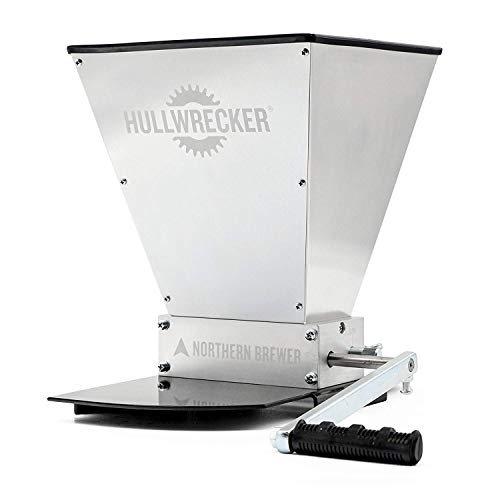
The Hullwrecker 2-Roller Grain Mill features a fully adjustable roller gap from 0.025” to 0.1”, allowing precise control over crush consistency. Its all-metal base is designed to fit standard 5- and 6.5-gallon brewing buckets, eliminating the need for an improvised stand. Built for long-term reliability, this model emphasizes straightforward operation and durable construction for frequent use.
FERRODAY Malted Grain Mill – 2 Roller

This model offers a large 7.7 lb hopper and a 5-inch roller pair with 12 TPI knurling to pull grains through while preserving hull integrity. The gap is adjustable from 0.025 to 0.1 inch, and a drill mode is available for high-throughput brewers who want to scale batch sizes. It is designed specifically for malted barley and malted wheat, making it a strong choice for hop-forward or malt-forward recipes.
Brewland Grain Mill (7.7 lb Hopper)
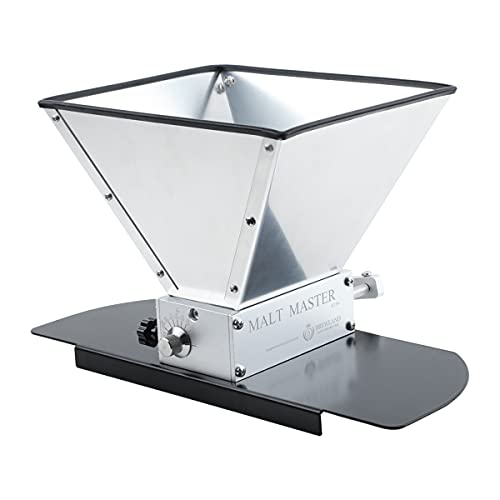
Brewland’s mill emphasizes two grinding modes: manual operation via a long crank or drill-assisted grinding through a low-speed drill. The 7.7 lb hopper supports larger batches, and the 8 mm hex-drive compatibility enables easy integration with common drill setups. The 0.025–0.1 inch roller gap range supports precise control of malt crush for efficient mashing while protecting grain husks.
Brewland Grain Mill Pro with 3 Rollers

This pro-grade model expands capacity with a 15 lb hopper and three rollers, offering enhanced throughput for large-batch brewers. The same 0.025–0.1 inch gap adjustment supports consistent crushing, while the appliance is compatible with electric drills for hands-free operation. A heavier build emphasizes stability during heavy use and reduces grain spillage.
FERRODAY Malted Grain Mill – Stainless 2 Roller
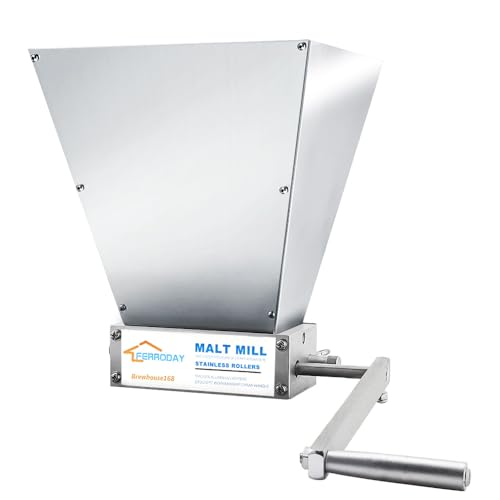
Equipped with a 7.7 lb hopper and 0.025–0.1 inch adjustable gap, this model emphasizes corrosion resistance and long-term durability with stainless steel rollers. A drill-compatible mode provides increased throughput for larger batches, making it suitable for frequent brewers who want efficient mash runs without sacrificing hull integrity.
DNYSYSJ Electric Grain Mill

This 110V electric grain mill uses a 60W geared motor to achieve up to approximately 20 kg (44 pounds) per hour in crush rate. It features stainless steel rollers with molybdenum-enhanced alloy for corrosion resistance, a 4L hopper, and upgrade options to extend capacity with hopper extensions. It’s designed for high-volume milling with a straightforward setup process.
RTUSUML Grain Mill
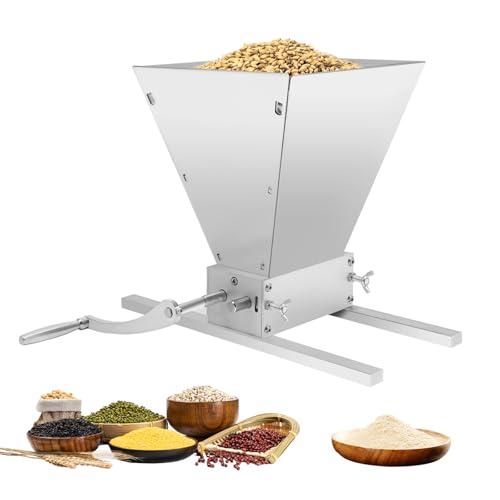
RTUSUML offers a 11 lb hopper with carbon steel rollers and a stainless steel housing and base. The adjustable roller gap (0–2.5 mm) supports precise control with minimal husk damage, suitable for uniform mash tun efficiency. Its large hopper capacity improves batch productivity for frequent brewers.
Buying Guide: Key Considerations When Choosing a Roller Mill
- Grind gap adjustability: Look for mills with a precise and easy-to-change gap (commonly 0.025–0.1 inch) to dial in crush size for your mash plan.
- Roller configuration: Two-roller systems are common and reliable; three-roller setups can improve throughput and achieve more even milling for larger batches.
- Hopper capacity: A larger hopper enables bigger batches between refills. Balance capacity with the mill’s footprint and stability on the work surface.
- Drill compatibility: If you plan to use an electric drill, ensure the mill supports a drill mode with a safe drive shaft and appropriate speed (low RPM to avoid overheating).
- Materials and durability: Stainless steel rollers and corrosion-resistant housings extend lifespan, especially when milling repeatedly with damp grains.
- Base stability: A solid, lockable base or bucket-milling setup reduces wobble, spills, and inconsistencies during grinding.
- Maintenance: Easy disassembly for cleaning, rust resistance, and parts availability affect long-term usability.
- 用途 and batch size: Choose based on your typical batch size—some mills are optimized for small-batch homebrew, others for large-batch operations.
When selecting a roller mill, align features with your brewing goals: annual brew volumes, preferred malt profiles, and whether you expect to mill malted barley, malted wheat, or other grains. A drill-ready model offers convenience for larger brews, while a sturdy manual mill is reliable for steady, lower-volume use. The featured options balance durability, adjustable crushing, and capacity to support consistent mash efficiency in American homebrewing setups.