Finding the right kitchen scale is essential for bread baking, where precise measurements influence dough hydration, texture, and rise. The following picks are designed for accurate gram-level readings, easy tare functions, and sturdy stainless steel construction. Each product is well-suited for measuring flour, water, starters, and toppings, helping bakers achieve consistent results across recipes. The table below highlights key details to compare quickly.
| Product | Brand | Capacity | Key Benefit |
|---|---|---|---|
| Etekcity Food Kitchen Scale (B0113UZJE2) | Etekcity | 11 lb / 5 kg | Compact stainless steel with precise 1 g increments |
| Mik-Nana Food Scale (B0BN4H1X9L) | Mik-Nana | 10 kg / 22 lb | Six units including ml for liquids |
| Food Scale 33 lb (B0BYN6Q8L7) | GGQ | 33 lb / 15 kg | Four load sensors, waterproof panel |
| Greater Goods Digital Food Scale (B09QFWXSD8) | Greater Goods | 22 lb / 10 kg | High-contrast LCD, bulk cooking ready |
| CROWNFUL Food Scale (B0CJR9GJSH) | CROWNFUL | 33 lb / 15 kg | Type-C or batteries, large readable panel |
Across these options, look for a tare function, multiple units (g, kg, lb, oz, ml), and a durable stainless steel surface. If you frequently measure large batches or use bulky bowls, prioritizing higher capacity and a clear display will save time and improve accuracy.
Etekcity Food Kitchen Scale

The Etekcity scale weighs up to 11 lb (5 kg) with 1 g increments and supports five units, including oz, lb, fl’oz, g, and mL. It features a tare function for container subtraction and comes with two AAA batteries for immediate use. Its compact, stainless steel design fits neatly in most kitchens, making it a practical choice for bakers measuring flour, water, or starter portions with precision.
Mik-Nana Digital Kitchen Scale

The Mik-Nana scale supports 10 kg / 22 lb capacity with 1 g / 0.1 oz resolution. It offers six units (g, kg, lb, oz, ml, milk ml), a tare function, and an easy-clean stainless steel surface. This versatility suits bread bakers who move between dough formulas requiring precise dry weights and liquid measurements, like hydration tests or starter builds. It balances accuracy with user-friendly operation for routines ranging from mixing to portion control.
GGQ Food Scale
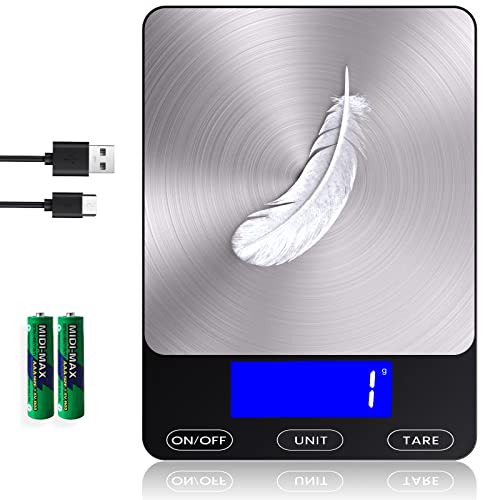
GGQ’s 33 lb (15 kg) digital scale uses four high-precision load sensors and a waterproof, anti-collision glass panel. It provides 1 g precision with 0.1 oz increments and supports multiple units (g/kg/lb:oz/oz/ml). The 7.5″ x 5.5″ stainless steel surface accommodates larger bowls, making it suitable for bulk baking or batch prep. A tare function helps isolate the weight of containers for accurate ingredient totals.
Greater Goods Digital Food Scale

This scale is built for bulk cooking and baking, weighing up to 22 lb (10 kg) with 1 g precision. It provides clear, high-contrast readings on a large LCD and supports common units (g, kg, lb:oz, oz, ml). The automatic hold and auto-shutoff features help when weighing sticky doughs or bulk flour batches, keeping the display readable and batteries from draining during long projects.
CROWNFUL Food Scale

The CROWNFUL scale offers a large 33 lb / 15 kg capacity with a Type-C charging option or two included AAA batteries. Its large stainless steel panel and slanted display improve visibility when handling bigger bowls or containers. With a 1 g precision and a broad measurement range, it fits regular bread-baking needs—from measuring starter portions to bulk flour blends—while staying convenient for daily use.
Buying Guide
Key purchase considerations for bread bakers include capacity, precision, and ease of use. For large batches or dense doughs, choose scales with higher weight limits (20–33 lb range) and 1 g or 0.5 g increments for accuracy in hydration testing. A tare function is essential to subtract bowl weight and obtain net ingredient weights. Unit versatility (g, kg, lb, oz, ml) helps with both dry ingredients and liquids without switching devices. A cleanable, stainless steel surface reduces crumb buildup and simplifies maintenance. Battery life and charging options (USB-C, Type-C, or rechargeable) are practical for frequent bakers. For stability, ensure a flat, non-slip base and a large enough platform to accommodate bowls used in bread making. Finally, durability and IP ratings (water resistance) can matter if the scale might endure flour spills or dough splashes in a busy kitchen.
In selecting among the five options above, consider your typical baking load: if you regularly bake large loaves or make multiple doughs in one session, a higher-capacity scale with a bright display and reliable tare is advantageous. If you often work with liquid starters or prefer features like a hold function for watching dough hydration, models with ml units and a clear long-press hold mode may suit you better. All listed options provide accurate, repeatable readings and practical features for home bakers aiming for consistent bread results.